
Medicare Tax Rate 2026 — Complete Guide to FICA, Rates & Calculations
What Is the Medicare Tax Rate in 2026?
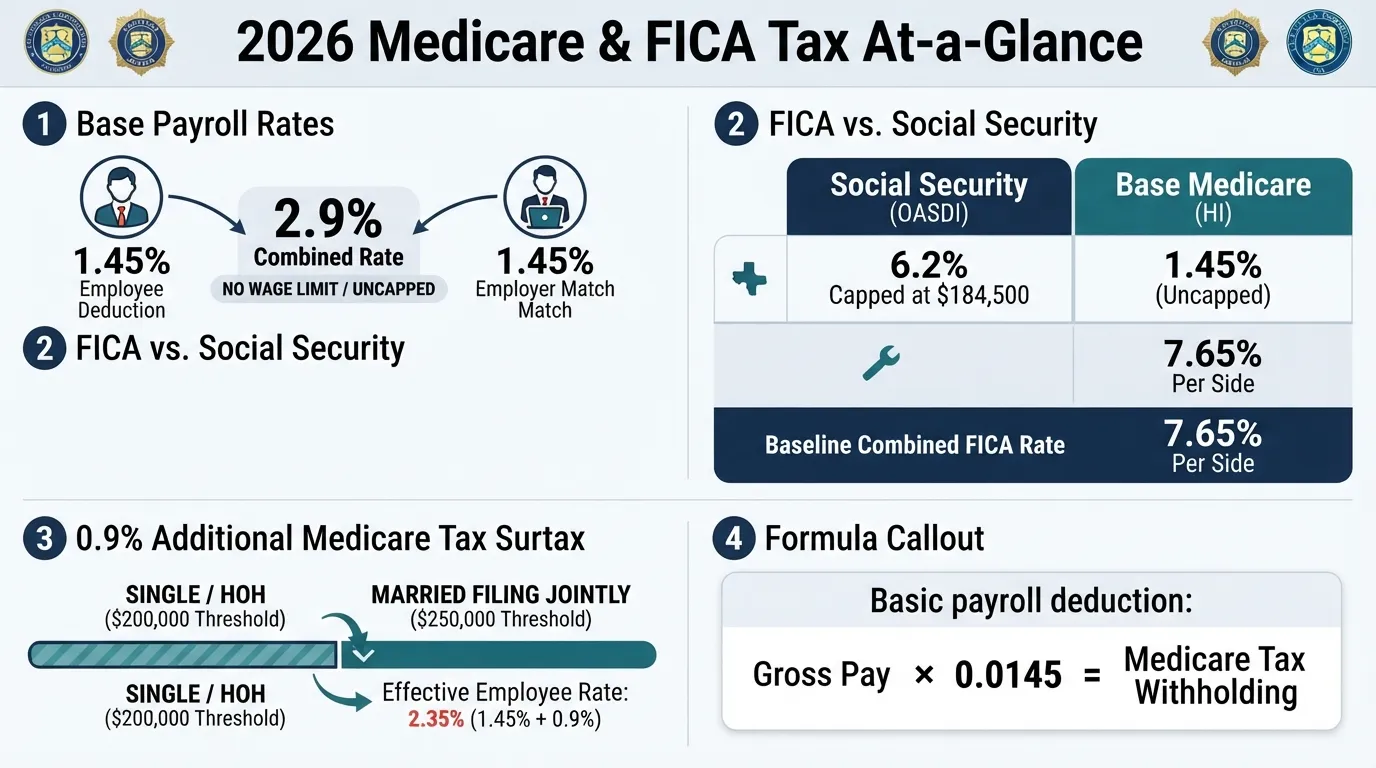
2026 Medicare Tax Rate: 1.45% employee + 1.45% employer = 2.9% combined total, with no wage base cap.
The base Medicare tax rate in 2026 is exactly 1.45% of gross pay for employees, matched equally by a 1.45% contribution from employers. Unlike Social Security tax, every single dollar of covered paycheck income is subject to this baseline deduction.
No Wage Base Limit — Applies to All Covered Wages
There is no maximum wage limit for standard Medicare tax in 2026. Whether an employee earns $30,000 or $3,000,000 during the tax year, the baseline 1.45% tax deduction applies to 100% of gross earnings without exception.
Medicare Tax Rate vs Social Security Tax Rate (2026)
Social Security and Medicare together make up FICA (Federal Insurance Contributions Act) tax, but they follow entirely different rules regarding wage caps and total tax limits.
Side-by-Side Comparison Table
| Tax Type | Employee Rate | Employer Rate | Combined Rate | 2026 Wage Base Cap |
|---|---|---|---|---|
| Social Security Tax | 6.20% | 6.20% | 12.40% | $184,500 |
| Medicare Tax (Base) | 1.45% | 1.45% | 2.90% | Uncapped |
| Additional Medicare Surtax | 0.90% | 0.00% | 0.90% | Applies above filing thresholds |
Combined FICA Rate = 7.65% Each
For standard wages up to $184,500, the employee payroll deduction for FICA is 7.65% (6.2% Social Security + 1.45% Medicare). Employers match this with an additional 7.65%, making the total FICA tax contribution 15.3%.
Additional Medicare Tax (0.9% Surtax) Explained
High-income earners are subject to an extra 0.9% Additional Medicare Tax under IRC Section 3101(b)(2). This surtax is strictly an employee tax—there is zero employer matching requirement.
Who Pays It — Thresholds Table
| Filing Status | 2026 Income Threshold | Surtax Rate Above Threshold |
|---|---|---|
| Single | $200,000 | 0.90% |
| Head of Household (HOH) | $200,000 | 0.90% |
| Married Filing Jointly (MFJ) | $250,000 | 0.90% |
| Married Filing Separately (MFS) | $125,000 | 0.90% |
Medicare Tax Rate for High-Income Earners
When an individual's wage income crosses the threshold for their filing status, the effective Medicare tax rate on all earnings above that line rises from 1.45% to 2.35% (1.45% base + 0.9% surtax).
Employer Withholding Rule
Employers must automatically begin withholding the 0.9% Additional Medicare Tax as soon as an employee's gross wages exceed $200,000 in a calendar year. Employers do not account for an employee's filing status or spousal income when withholding.
Reconciling on Tax Return (Form 8959)
Because payroll withholding is calculated per job, high earners reconcile their actual liability on IRS Form 8959 when filing Form 1040. Any over-withheld tax acts as a credit, while under-withheld amounts (common in dual-income joint households) are paid as additional tax due.
3.8% NIIT vs 0.9% Additional Medicare Tax (Don't Confuse These)
While both taxes use similar income thresholds ($200k Single / $250k MFJ), they target different types of income:
- 0.9% Additional Medicare Tax: Applies strictly to earned paycheck wages and self-employment earnings.
- 3.8% Net Investment Income Tax (NIIT): Applies strictly to unearned investment income (dividends, capital gains, interest, rental income). It is entirely separate from payroll taxes.
Medicare Tax for Self-Employed Individuals
Self-employed taxpayers pay Medicare taxes under SECA (Self-Employment Contributions Act) instead of standard FICA payroll taxes.
SECA — Full 2.9% Medicare Rate
Because self-employed workers act as both employer and employee, they pay the combined base Medicare tax rate of 2.9% (1.45% + 1.45%) on all net business profit, plus 12.4% Social Security on net income up to $184,500.
Additional 0.9% Surtax on Self-Employment Income
When net self-employment profit exceeds filing thresholds ($200,000 Single / $250,000 MFJ), the total Medicare portion of self-employment tax on earnings above the limit reaches 3.8% (2.9% base + 0.9% surtax).
Deduction of "Employer Half" for Self-Employed
Self-employed taxpayers can deduct the 50% employer portion of their base SECA tax (1.45% for Medicare) as an above-the-line deduction on Schedule 1 of Form 1040 to reduce their overall AGI.
How to Calculate Your Medicare Tax (Step-by-Step)
Formula & Example Calculation ($60,000 Salary)
Standard formula: Medicare Tax = Gross Pay × 0.0145
Example for High Earner Crossing Surtax Threshold
Calculation for a Single taxpayer earning $260,000 in salary:
Calculate your net pay and exact Medicare withholding instantly
Open Paycheck Calculator ToolMedicare Tax Rate History
The standard baseline Medicare tax rate has remained remarkably stable for decades, with the primary addition being the 2013 high-income surtax.
| Tax Years | Employee Rate | Employer Rate | High-Income Surtax | Wage Cap |
|---|---|---|---|---|
| 2013 – 2026 | 1.45% | 1.45% | 0.90% (Above threshold) | None (Uncapped) |
| 1994 – 2012 | 1.45% | 1.45% | None | None (Uncapped) |
| 1991 – 1993 | 1.45% | 1.45% | None | $125,000 – $135,000 |
| 1986 | 1.45% | 1.45% | None | $42,000 |
Who Pays Medicare Tax? (Coverage & Exceptions)
The vast majority of working Americans pay Medicare payroll taxes, though specific statutory exceptions exist under federal law:
- Covered Employees: W-2 corporate, non-profit, and governmental workers.
- Self-Employed Individuals: Sole proprietors, freelancers, independent contractors, partners, and active LLC members.
- Exceptions & Exemptions:
- State and local employees hired prior to April 1, 1986 who participate in qualifying alternative public retirement programs.
- Certain foreign students and scholars holding temporary F-1, J-1, M-1, or Q-1 visas.
- Members of qualified religious groups with approved Form 4029 social security exemptions.
- Emergency responders and firefighters hired post-March 1986 covered under designated local pension systems.
Frequently Asked Questions (FAQs)
• Social Security Administration: SSA.gov Tax Rates Table
• Internal Revenue Service: IRS.gov Additional Medicare Tax (Topic 560)
0 Comments