
13 Common Payroll Errors and How They Affect Your Paycheck
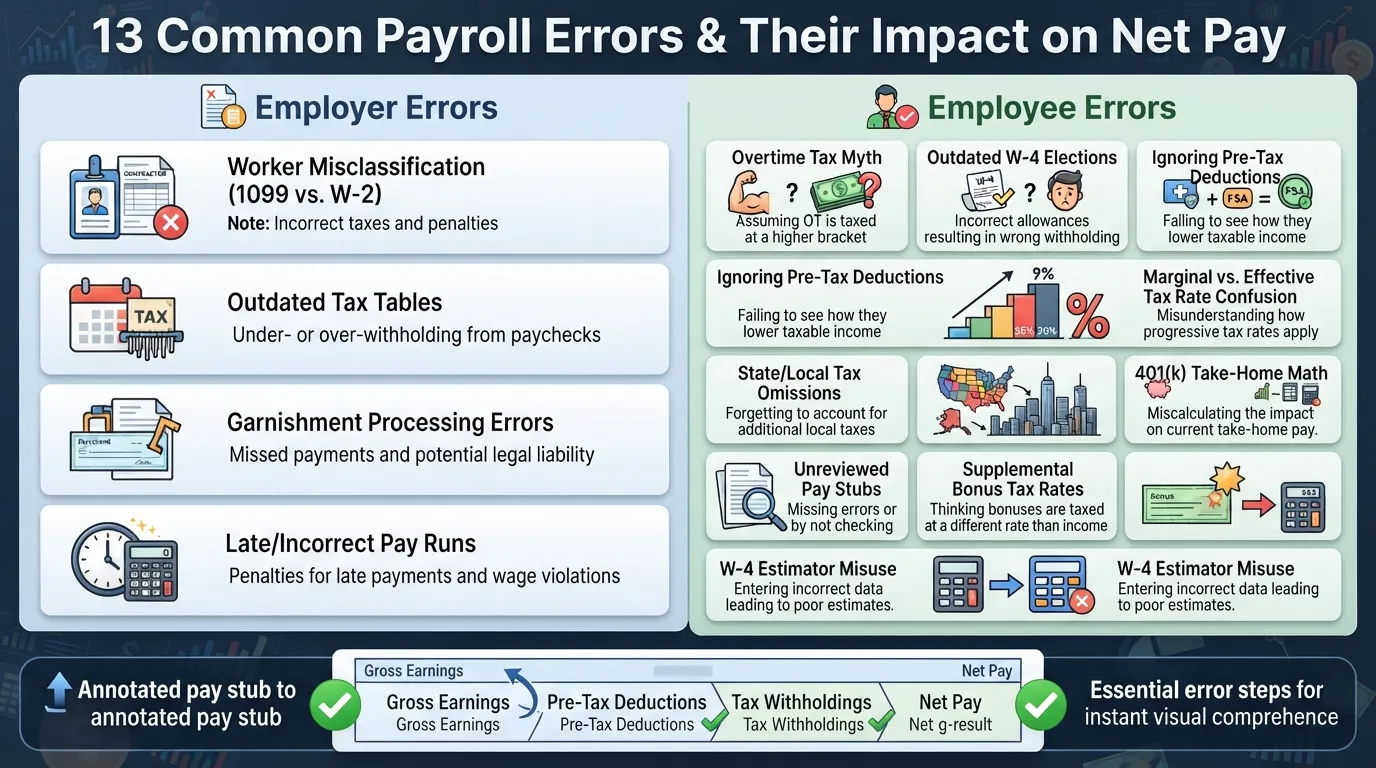
Payroll mistakes happen more often than you'd think — whether it's an employer misclassifying a worker, an outdated tax table shorting your withholding, or you misreading your own overtime pay. Below are 13 of the most common errors on both sides of the paycheck, what causes them, and how to spot one before it costs you money.
Employer-Side Payroll Mistakes That Show Up on Your Paycheck
Worker Misclassification (1099 vs. W-2)
When a business labels you an independent contractor (1099) instead of an employee (W-2) to avoid paying payroll taxes, you absorb the full financial burden. W-2 employees split FICA taxes with their employer (you pay 6.2% for Social Security and 1.45% for Medicare, and they match it). If misclassified as a 1099 contractor, you owe the entire 15.3% Self-Employment Contributions Act (SECA) tax yourself, while forfeiting overtime pay, workers' compensation, and unemployment benefits.
Under Department of Labor rules, classification comes down to economic dependence and control. If your boss dictates your precise working hours, supplies your tools, restricts you from working for competitors, and controls how your job is done, you are an employee under the law, regardless of what contract you signed.
Outdated Tax Tables / Incorrect Withholding Setup
The IRS adjusts tax brackets, standard deductions, and income thresholds every year. For 2026, the standard deduction rises to $16,100 for single filers and $32,200 for married couples filing jointly. If payroll software is not updated with 2026 IRS Publication 15-T withholding tables, it will calculate federal income tax using obsolete baseline thresholds.
Similarly, setup human error — like entering a single filer as married, or omitting local wage tax codes — can cause system-wide withholding errors. If payroll under-withholds taxes all year, you won't realize it until April, when you suddenly owe the IRS money alongside underpayment penalties.
Garnishment Processing Errors
Wage garnishments for child support, tax levies, or court orders have strict legal priority and statutory caps under Title III of the Consumer Credit Protection Act (CCPA). Ordinary debt garnishments are capped at 25% of your disposable earnings (or the amount by which weekly disposable pay exceeds 30 times the federal minimum wage, whichever is less).
Employers make processing errors when they calculate garnishments against gross pay instead of disposable earnings (gross income minus legally required deductions like FICA and income taxes). Over-deducting leaves you without enough money to live on, while under-deducting leaves the employer liable to the court or creditor for the unpaid balance.
Late or Incorrect Payroll Runs
Under the Fair Labor Standards Act (FLSA), employees must be paid on a regular, predictable pay date. Delaying a payroll run by even a few days disrupts automatic bill payments, triggers personal bank overdraft fees, and violates state wage payment laws.
A second common run error is manual entry mistakes — like entering 80 hours worked as 8.0, or miscalculating salary prorations for someone starting mid-pay-period. Modern payroll software eliminates these manual calculation errors, but human input mistakes still happen when data isn't verified before approval.
Paycheck Calculation Mistakes Employees Make
Mistake 1 — Overtime "Special Tax Rate" Myth
One of the most persistent paycheck myths is that overtime pay is taxed at a special, higher tax rate that "eats up all your extra earnings." That is mathematically false. Overtime is taxed as regular income; it does not trigger a special tax penalty.
The confusion happens because automated payroll software estimates your taxes on a per-pay-period basis. If you work 20 hours of overtime, your gross check for that week spikes significantly. The system assumes you make that inflated amount every single pay period all year, which pushes that specific check into a higher withholding bracket. However, when you file your annual tax return, your actual liability is calculated on your total annual income — meaning any excess tax withheld on that overtime check is refunded back to you.
Mistake 2 — Not Updating Your W-4
The IRS completely redesigned Form W-4, eliminating withholding allowances in favor of a dollar-value wage calculation system. If you haven't updated your W-4 since getting married, having a child, taking on a second job, or having a spouse re-enter the workforce, your withholding is almost certainly inaccurate.
For example, if both you and your spouse work but both check "Married Filing Jointly" on Step 1 without completing the Multiple Jobs worksheet on Step 2, the system will apply the full married standard deduction ($32,200 for 2026) to both paychecks. This effectively double-counts your deduction, resulting in severe tax under-withholding.
Mistake 3 — Ignoring Pre-Tax Deductions
Failing to take advantage of pre-tax deductions means paying unnecessary income and payroll taxes. Contributions to traditional 401(k)s, Health Savings Accounts (HSAs), Flexible Spending Accounts (FSAs), and pre-tax commuter benefits lower your taxable gross pay.
| Deduction Type | Federal Income Tax | FICA Tax (7.65%) | 2026 Contribution Cap |
|---|---|---|---|
| Traditional 401(k) / 403(b) | Exempt (Pre-Tax) | Subject to FICA | $24,500 ($32,500 if 50+) |
| HSA (Payroll) | Exempt (Pre-Tax) | Exempt (Saves 7.65%) | $4,300 / $8,550 |
| Healthcare FSA | Exempt (Pre-Tax) | Exempt (Saves 7.65%) | $3,300 limit |
Notice that while 401(k) contributions lower your income tax, section 125 cafeteria benefits like HSAs and FSAs lower your Social Security and Medicare taxes too.
Mistake 4 — Marginal vs Effective Tax Rate Confusion
A widespread point of confusion is assuming that jumping into a higher marginal tax bracket lowers your overall take-home pay. The U.S. federal income tax uses a progressive tax bracket system — meaning your money is taxed in distinct income layers, like steps on a ladder.
For 2026, single filers face the following federal brackets:
- 10% on income up to $12,400
- 12% on income from $12,401 to $50,400
- 22% on income from $50,401 to $105,700
- 24% on income from $105,701 to $201,775
If your taxable income increases from $50,000 to $52,000, you don't pay 22% on all $52,000. You pay 10% on the first $12,400, 12% on the portion up to $50,400, and 22% only on the $1,600 that sits above the threshold. Your marginal rate is 22%, but your effective rate (total tax divided by total income) is only around 11.2%. Earning more gross pay always results in more net take-home pay.
Mistake 5 — Forgetting State/Local Taxes
Calculating pay based solely on federal taxes leads to major paycheck surprises. State Income Taxes (SIT) range from 0% in tax-free states like Texas, Florida, and Washington up to over 13% in top California brackets.
Furthermore, local occupational taxes, county income taxes (like Indiana's county tax or Maryland's local tax), and city wage taxes (such as in Philadelphia, New York City, or Ohio municipalities) can slice another 1% to 4% off your take-home pay. Remote workers are particularly vulnerable to double-taxation issues if their employer fails to set up state tax withholding correctly for their home residency state.
Mistake 6 — 401(k) Dollar-for-Dollar Assumption
When you sign up to put $200 per pay period into a pre-tax 401(k), many employees expect their net take-home pay to drop by exactly $200. It doesn't.
Because that $200 is deducted before federal and state income taxes are calculated, your taxable income drops. If you are in the 22% federal marginal bracket and pay a 5% state tax, saving $200 pre-tax reduces your tax withholding by $54 ($200 × 27%). That means your actual take-home pay only drops by $146, while a full $200 goes straight into your investment account.
Pro Tip: Want to see the exact real-dollar impact of changing your retirement contributions? Use PayscheckCalculator.com's paycheck calculator to model different 401(k) percentages and preview your net pay before making changes in HR portal.
Mistake 7 — Not Reviewing Pay Stub
Assuming your paycheck is accurate without opening your pay stub is a risky habit. Software glitches, unapplied wage increases, missed shift differentials, and expired tax exemptions happen every day.
Reviewing your pay stub every pay period takes under two minutes. You should verify three key areas: gross pay accuracy (regular hours, overtime hours, hourly rate), pre-tax/post-tax deduction amounts, and cumulative year-to-date (YTD) earnings and tax totals.
Mistake 8 — Bonus Withholding Confusion
When you get a performance bonus, commission check, or severance payout, you might be shocked to see nearly 30% to 40% disappear to taxes. This happens because the IRS classifies bonuses as supplemental wages.
Employers generally handle supplemental wage withholding using one of two options:
- Flat Percentage Method: The employer withholds a flat 22% federal income tax rate on supplemental pay up to $1 million (37% on amounts over $1 million). When you add 7.65% FICA tax plus state taxes, total withholding easily reaches 35%+.
- Aggregate Method: The employer combines your bonus with your regular pay on a single check and taxes the whole amount using standard withholding tables. This temporarily pushes you into a much higher temporary bracket for that single pay check.
Mistake 9 — Not Using IRS Withholding Estimator
Relying on guesswork when filling out your W-4 often leads to a massive tax bill or an accidentally large tax refund (which is simply an interest-free loan to the government).
The IRS provides a free online Withholding Estimator tool designed to calculate your exact tax position. Running your numbers through the tool midway through the year — especially after major life changes like marriage, home purchases, or job changes — ensures your withholding lines up perfectly with your real annual tax liability.
Why These Errors Matter (Cost & Risk)
Uncorrected payroll mistakes create serious legal and financial liabilities for both employers and employees:
- Financial & Penalty Risk for Employers: The IRS imposes Trust Fund Recovery Penalties (TFRP) of up to 100% of unpaid payroll taxes on business owners and payroll managers who fail to remit withheld FICA and income taxes. Additionally, Department of Labor audit penalties for FLSA overtime violations include back-pay liabilities, liquidated damages equal to 100% of unpaid wages, and civil penalties exceeding $2,000 per violation.
- Impact on Employee Take-Home Pay: For workers, unnoticed withholding errors lead to unexpected multi-thousand-dollar IRS tax bills, underpayment interest charges, and penalties at tax time. On the flip side, undetected wage underpayments starve household budgets, while unnoticed 401(k) contribution lapses mean missing out on valuable employer matching dollars and long-term compound growth.
Quick Checklist — How to Check Your Paycheck for Errors
Run through this 6-point audit checklist every pay period to catch errors early:
- ✓ Verify Pay Rate & Hours: Cross-check your logged timecards against the gross hours (regular, overtime, PTO) listed on your stub.
- ✓ Check Overtime Math: Confirm overtime hours worked over 40 in a workweek are calculated at 1.5 times your regular hourly rate.
- ✓ Audit Deductions: Confirm pre-tax deductions (401k, HSA, health insurance) match your elected contribution amounts.
- ✓ Review Filing Status: Verify that your pay stub reflects the correct W-4 status (Single, Married, Head of Household).
- ✓ Monitor FICA Caps: If you're a high earner, track your Social Security YTD earnings against the annual wage cap to ensure deductions stop once hit.
- ✓ Confirm Direct Deposit Split: Ensure net pay is accurately distributed across your designated bank checking and savings accounts.
What to Do If You Find a Payroll Error
Specific Steps to Report It (proof needed, timeline)
If you spot an error on your pay stub, act quickly and systematically:
- Gather Documentation: Collect copies of your pay stub, approved timecards, offer letter, or written benefit contribution agreements showing what you should have been paid or deducted.
- Contact Payroll/HR in Writing: Send a polite, clear email outlining the discrepancy. State the pay period date, the specific line-item error (e.g., "shorted 4 hours of overtime on the July 15 check"), and attach your supporting time logs.
- Follow Up: Keep a personal copy of all correspondence, dates, and names of representatives you speak with regarding the issue.
How Long Employers Have to Correct It
Under state wage payment laws, employers are generally required to correct underpayments on the next scheduled regular pay date following notification. However, if the error results in a significant financial hardship (such as missing a full paycheck), many states mandate that employers issue a supplemental manual check within 3 to 5 business days.
When to Escalate to DOL Wage and Hour Division
If your employer refuses to correct a valid wage error, repeatedly delays pay, or retaliates against you for asking, you can file a wage claim with the federal Department of Labor (DOL) Wage and Hour Division or your state's Labor Board. Under federal law, the statute of limitations for recovering back wages under the FLSA is 2 years for standard violations and 3 years for willful violations.
Watch: Top Payroll Mistakes Explained
For a detailed visual overview of payroll errors and how they impact business compliance and employee paychecks, watch this breakdown:
FAQs
What is the 7-minute rule for payroll?
The 7-minute rule (or 15-minute rounding rule) is an IRS and DOL-approved practice that allows employers to round employee clock-in and clock-out times to the nearest quarter-hour. Under 29 CFR § 785.48(b), minutes 1 through 7 round down to the previous 15-minute increment, while minutes 8 through 14 round up to the next 15-minute mark. Crucially, the rule must be applied neutrally — an employer cannot round down when you arrive late but refuse to round up when you work past your shift.
How to handle payroll errors?
Employees should document the issue, gather timecard or benefit records, and submit a written request to HR or payroll detailing the error. Employers should investigate immediately, issue a supplemental paycheck or manual adjustment, and document the resolution in the employee's file to maintain tax and labor law compliance.
Who is responsible for payroll errors?
Legally, the employer bears ultimate financial and legal responsibility for paying workers accurately, remitting tax withholdings to state and federal agencies, and maintaining compliance with FLSA laws. However, employees share practical responsibility for keeping their W-4 tax elections updated, reviewing pay stubs, and reporting discrepancies promptly.
Does HR handle payroll issues?
In small to mid-sized businesses, Human Resources often manages payroll directly or works alongside a dedicated payroll specialist. In larger corporations, HR handles benefit enrollments, wage adjustments, and W-4 setup, while a dedicated Payroll or Accounting department handles tax calculations, direct deposits, and pay runs.
How difficult is payroll?
Payroll complexity depends on workforce size, worker classification, and jurisdiction. While calculating straight hourly wages for W-2 staff in one state is straightforward, managing multi-state tax withholdings, overtime calculations, local wage taxes, health insurance deductions, pre-tax 401(k) caps, and court-ordered garnishments requires specialized software or a certified payroll professional.
📌 Related Articles You Might Like
How To Figure Out How Much You Make A Month
https://payscheckcalculator.com/blog/how-to-figure-out-how-much-you-make-a-month/
Visit This Blog →How To Calculate Monthly Income From Biweekly Paycheck
https://payscheckcalculator.com/blog/how-to-calculate-monthly-income-from-biweekly-paycheck/
Visit This Blog →How To Get Less Taxes Taken Out Of My Paycheck
https://payscheckcalculator.com/blog/how-to-get-less-taxes-taken-out-of-my-paycheck/
Visit This Blog →How To Fill Out W4 Form
https://payscheckcalculator.com/blog/how-to-fill-out-w4-form/
Visit This Blog →
Written & verified by Daniel R. Whitmore
Founder & Developer, PayCheckCalculator.com
Last updated: July 2026
0 Comments