
Biweekly vs Semi-Monthly Pay: Which One Puts More Money in Your Pocket?
Many people confuse biweekly with semi-monthly pay. They are NOT the same. Biweekly means you get paid every 2 weeks, which gives you 26 paychecks per year. Semi-monthly means you get paid twice per month on specific dates, which gives you 24 paychecks per year. This difference affects your paycheck amount, monthly budget, and how you plan your finances.
Biweekly vs Semi-Monthly

Biweekly Pay:
You get paid every 2 weeks.
52 weeks per year divided by 2 equals 26 paychecks per year.
Most months you get 2 paychecks.
Two months per year you get 3 paychecks.
Paychecks are smaller but more frequent.
Paydays are always on the same weekday, such as every other Friday.
Semi-Monthly Pay:
You get paid twice per month on specific dates.
12 months times 2 equals 24 paychecks per year.
Every month you get exactly 2 paychecks.
Paychecks are larger but less frequent.
Paydays are on fixed dates, such as the 15th and the last day of the month.
Pay dates may fall on weekends, which may require adjustment to the nearest business day.
Biweekly Pay Explained — 26 Paychecks Per Year

Biweekly pay means you receive a paycheck every two weeks. There are 52 weeks in a year, so 52 divided by 2 equals 26 paychecks per year.
Your paydays are always on the same weekday. For example, if you get paid on a Friday, you will receive your paycheck every other Friday.
Most months have 2 paychecks. However, two months each year will have 3 paychecks. These are called 3-paycheck months.
Biweekly pay is very common for hourly workers because it aligns with the standard 40-hour workweek. Overtime calculation is also easier with biweekly pay because each pay period covers two full workweeks.
Example: If you earn $60,000 per year, your biweekly paycheck is $60,000 divided by 26, which equals $2,307.69 per paycheck before taxes.
Semi-Monthly Pay Explained — 24 Paychecks Per Year
Semi-monthly pay means you receive a paycheck twice per month on specific dates. Most companies choose the 15th and the last day of the month. Some companies choose the 1st and the 15th.
There are 12 months in a year, and each month has 2 paychecks. So 12 times 2 equals 24 paychecks per year.
Every month has exactly 2 paychecks. There are no 3-paycheck months with semi-monthly pay. This makes budgeting simpler because you always know exactly how many paychecks to expect each month.
Your paycheck amount is larger because your annual salary is divided by 24 instead of 26. However, your payday may fall on a Saturday or Sunday. When this happens, you may get paid on the Friday before or the Monday after. Most employers adjust paydays to the nearest business day.
Semi-monthly pay is very common for salaried employees because it aligns well with monthly bills like rent, mortgage, and car payments. Since your bills are due once per month, receiving two paychecks each month makes it easier to plan your budget.
Example: If you earn $60,000 per year, your semi-monthly paycheck is $60,000 divided by 24, which equals $2,500.00 per paycheck before taxes.
3-Paycheck Months in 2026 — When You Get an Extra Paycheck
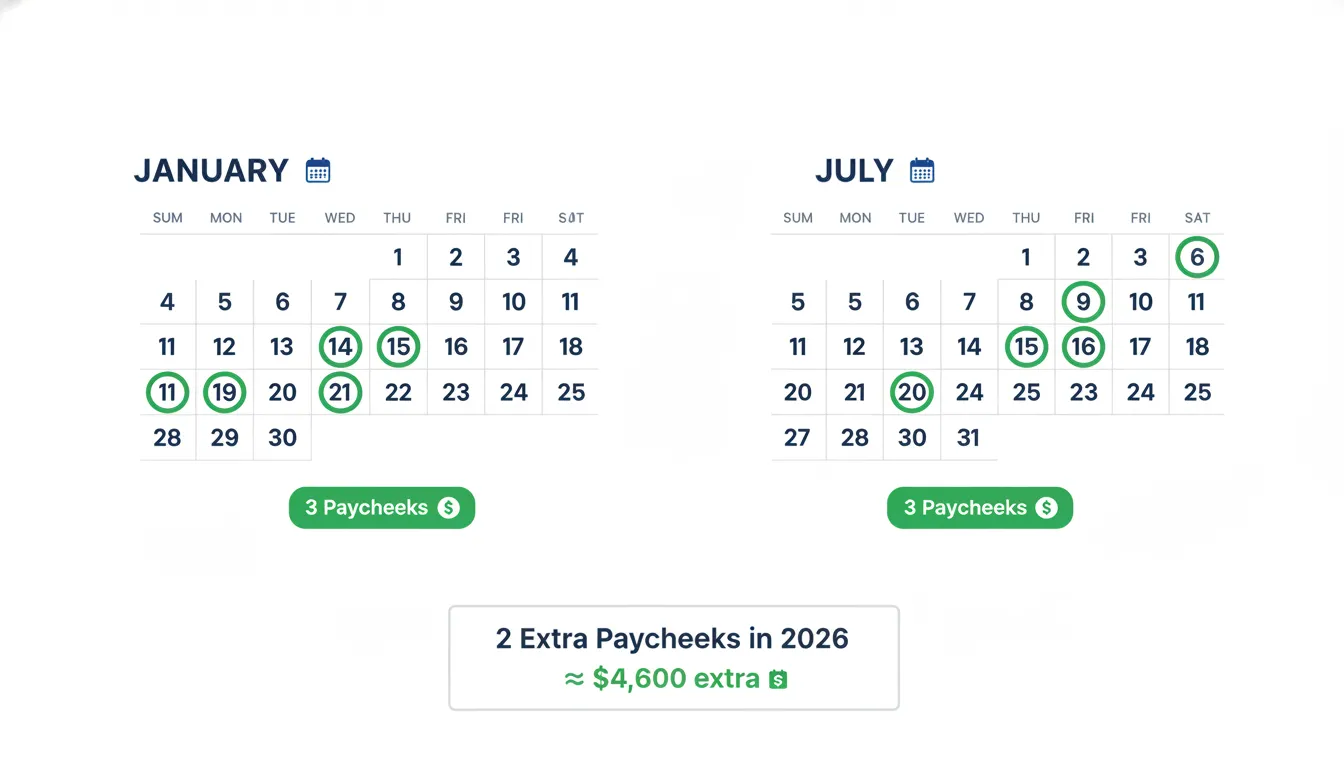
With biweekly pay, you receive 26 paychecks per year. Since there are only 12 months, two months each year will have 3 paychecks instead of 2.
2026 3-Paycheck Months Calendar If paid on Fridays:
January: Paycheck dates are 2nd, 16th, and 30th. The extra paycheck amount is your full paycheck amount.
July: Paycheck dates are 3rd, 17th, and 31st. The extra paycheck amount is your full paycheck amount.
Note: Your exact 3-paycheck months depend on your specific payday. If you are paid on a different day of the week, your months may vary. Check your company’s pay calendar for exact dates.
How to Budget for 3-Paycheck Months:
Strategy 1 — Treat it as bonus money. Budget based on only 2 paychecks per month. When the 3rd paycheck arrives, treat it as extra money. Use it for debt, savings, or investments. This is the simplest strategy.
Strategy 2 — Calculate your average monthly income. Use the formula: Biweekly Pay times 26 divided by 12 equals your average monthly income. Budget based on this average amount. In months with only 2 paychecks, you may need to use some savings. In months with 3 paychecks, you will have extra to replenish savings.
Strategy 3 — Use it for annual expenses. Use the extra paycheck to pay for expenses that come once a year, such as property taxes, insurance premiums, or holiday shopping. This way, these large expenses do not disrupt your regular monthly budget.
What to do with your extra paycheck:
Pay off credit card debt to save on interest charges.
Add to your emergency fund to reach 3 to 6 months of expenses.
Make an extra mortgage or car payment to pay off debt faster.
Invest for retirement to take advantage of compound growth.
Save for a vacation or home repairs without using credit cards.
Pro Tip: If you receive two 3-paycheck months per year, that is 2 extra paychecks annually. After 5 years, that is 10 extra paychecks saved. This can significantly boost your savings or help you pay off debt much faster.
Paycheck Amount Comparison — How Much You Get Each Payday
With the same annual salary, your biweekly paycheck is smaller than your semi-monthly paycheck. However, you receive more paychecks per year.
Example with $60,000 annual salary:
For biweekly pay, your annual salary is $60,000. You receive 26 paychecks per year. Your per paycheck amount is $2,307.69.
For semi-monthly pay, your annual salary is $60,000. You receive 24 paychecks per year. Your per paycheck amount is $2,500.00.
The difference is $192.31 more with semi-monthly pay per paycheck.
Example with $50,000 annual salary:
For biweekly pay, your annual salary is $50,000. You receive 26 paychecks per year. Your per paycheck amount is $1,923.08.
For semi-monthly pay, your annual salary is $50,000. You receive 24 paychecks per year. Your per paycheck amount is $2,083.33.
The difference is $160.25 more with semi-monthly pay per paycheck.
Key Takeaway: Your total annual pay is exactly the same with both schedules. The difference is how much you receive each paycheck and how often you receive it. Biweekly gives you smaller checks but more of them. Semi-monthly gives you larger checks but fewer of them.
Pros and Cons — Biweekly vs Semi-Monthly
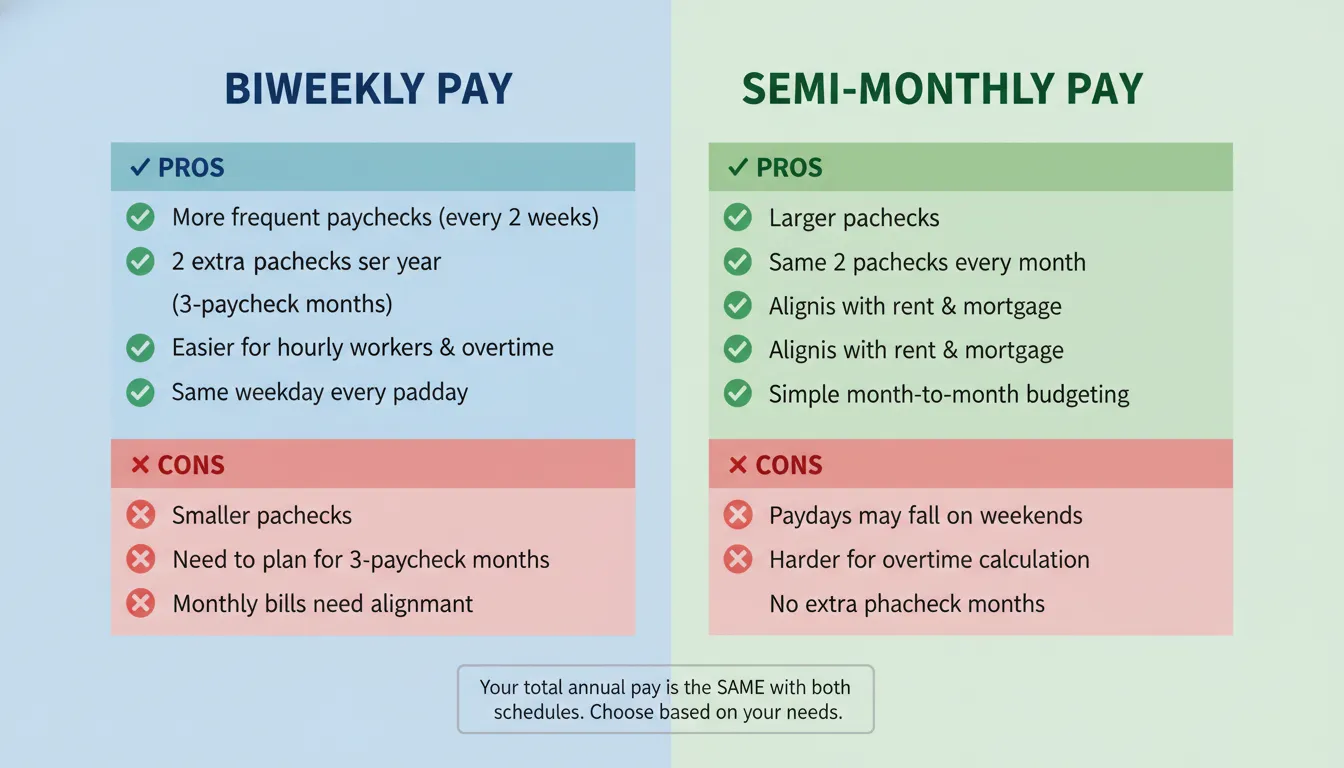
Biweekly Pay — Pros:
More frequent paychecks. You get paid every 2 weeks, so money comes in more often.
Two extra paychecks per year. You get 26 paychecks instead of 24, which means two 3-paycheck months each year.
Easier for hourly workers and overtime calculation. Biweekly pay aligns perfectly with the standard 40-hour workweek.
Aligns with weekly work schedule. Your pay period covers two full workweeks, making time tracking simple.
Predictable paydays. You always get paid on the same weekday, such as every other Friday.
Biweekly Pay — Cons:
Paychecks are smaller. Your annual salary is divided into 26 parts instead of 24, so each check is smaller.
Budgeting requires planning for 3-paycheck months. You need to plan for months when you receive 3 paychecks instead of 2.
Monthly bills need to be aligned with your pay schedule. Rent, mortgage, and car payments are due once per month, but you get paid every 2 weeks.
Two months per year have higher cash flow needs. Your employer needs to process three payrolls in those months instead of two.
Semi-Monthly Pay — Pros:
Larger paychecks. Your annual salary is divided into 24 parts instead of 26, so each check is larger.
Same number of paychecks each month. You always get exactly 2 paychecks every month, with no exceptions.
Easier for monthly bill payments. Rent, mortgage, and car payments align perfectly with your twice-per-month pay schedule.
Predictable budgeting month to month. You always know exactly how much money you will receive each month.
Fewer payroll runs for employers. Processing 24 payrolls per year instead of 26 saves time and money.
Semi-Monthly Pay — Cons:
Paychecks are less frequent. You get paid twice per month instead of every 2 weeks, so you wait longer between paychecks.
Paydays may fall on weekends. When the 15th or last day falls on a Saturday or Sunday, you may get paid on Friday or Monday.
Harder to calculate overtime for hourly workers. Semi-monthly pay periods do not always align with full workweeks, making overtime calculation complex.
No extra paycheck months. You never receive a 3-paycheck month with semi-monthly pay.
Which Pay Schedule is Better for You? — Decision Guide
Choose Biweekly Pay if:
You are paid hourly. Biweekly pay aligns perfectly with hourly work schedules.
You work overtime regularly. Overtime calculation is much simpler with biweekly pay because each pay period covers two full workweeks.
You want more frequent paychecks. Getting paid every 2 weeks means money comes in more often.
You can manage 3-paycheck months. You need to plan for the two months each year when you receive 3 paychecks instead of 2.
You prefer getting paid every 2 weeks on the same day. Biweekly paydays are always on the same weekday, such as every other Friday.
You want two extra paychecks per year for savings or debt. The two 3-paycheck months give you extra money to put toward your financial goals.
Choose Semi-Monthly Pay if:
You are salaried. Your annual salary is simply divided into 24 equal payments.
You have fixed monthly bills such as rent, mortgage, or car payment. Semi-monthly pay aligns perfectly with monthly due dates.
You prefer predictable paycheck amounts. Every paycheck is exactly the same amount throughout the year.
You want simpler budgeting month to month. You always receive exactly 2 paychecks every month, with no exceptions.
You want larger paychecks, even if they are less frequent. Your annual salary is divided into 24 parts instead of 26, so each check is larger.
You do not want to manage 3-paycheck months. With semi-monthly pay, you never receive an extra paycheck.
Quick Answer:
Hourly worker who works overtime: Better choice is Biweekly.
Salaried professional with monthly bills: Better choice is Semi-Monthly.
Want more frequent paychecks: Better choice is Biweekly.
Want larger paychecks: Better choice is Semi-Monthly.
Can manage 3-paycheck months: Better choice is Biweekly.
Want simple month-to-month budgeting: Better choice is Semi-Monthly.
Industry Guide — Common Pay Schedules by Industry
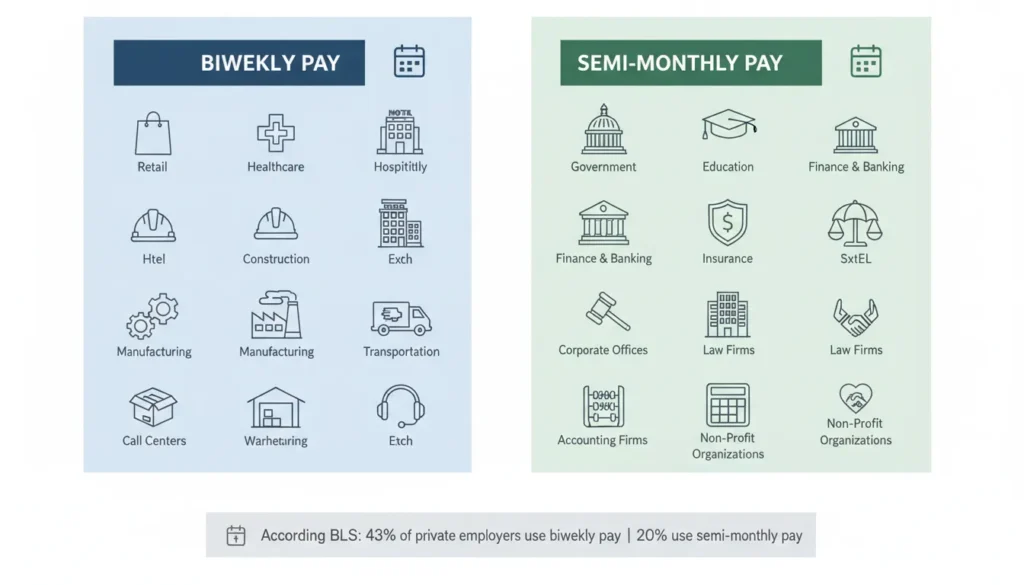
Retail stores and chains commonly use biweekly pay for their hourly store associates and managers.
Healthcare facilities including hospitals and clinics use biweekly pay for nurses, technicians, and administrative staff.
Hospitality businesses such as hotels and restaurants use biweekly pay for servers, housekeepers, and front desk employees.
Construction companies use biweekly pay for laborers, carpenters, electricians, and equipment operators.
Manufacturing plants use biweekly pay for assembly line workers, machine operators, and quality control staff.
Transportation and logistics companies use biweekly pay for drivers, warehouse workers, and dispatchers.
Warehousing operations use biweekly pay for pickers, packers, and forklift operators.
Call centers use biweekly pay for customer service representatives and team leads.
Industries That Typically Use Semi-Monthly Pay:
Government agencies at the federal, state, and local level use semi-monthly pay for their employees.
Education institutions including public schools, colleges, and universities use semi-monthly pay for teachers, professors, and administrators.
Finance and banking institutions use semi-monthly pay for bankers, analysts, and financial advisors.
Insurance companies use semi-monthly pay for agents, adjusters, and underwriters.
Corporate office positions across various industries use semi-monthly pay for managers, directors, and executives.
Law firms use semi-monthly pay for attorneys, paralegals, and legal secretaries.
Accounting firms use semi-monthly pay for accountants, auditors, and tax professionals.
Non-profit organizations use semi-monthly pay for program coordinators, development staff, and administrative personnel.
Statistic: According to the Bureau of Labor Statistics, 43 percent of private employers use biweekly pay, while approximately 20 percent use semi-monthly pay. The remaining employers use weekly or monthly pay schedules.
Biweekly vs Semi-Monthly Pay Calculator — Compare Your Pay
Use the calculator below to see how your paychecks compare between biweekly and semi-monthly pay schedules based on your annual salary.
Calculator Inputs:
Annual Salary — Enter your yearly income before taxes. Default is $60,000.
Pay Schedule Toggle — Switch between Biweekly and Semi-monthly to see how each schedule affects your paycheck.
Calculator Outputs:
Biweekly Paycheck Amount — Your gross pay per paycheck if paid every 2 weeks (26 paychecks per year).
Semi-Monthly Paycheck Amount — Your gross pay per paycheck if paid twice per month (24 paychecks per year).
Difference in Paycheck Amount — How much more or less you receive per paycheck with each schedule.
Paychecks Per Year — 26 paychecks for biweekly vs 24 paychecks for semi-monthly.
Monthly Income Comparison — Your average monthly income under both pay schedules.
The calculator below updates instantly as you change your annual salary. No buttons to click. Just enter your salary and see your results immediately.
Figuring out the “perfect” percentage to deduct from your paycheck can be overwhelming. While everyone’s financial situation is unique, there are three industry-standard “Golden Rules” that can help you decide.
Frequently Asked Questions — Biweekly vs Semi-Monthly Pay
It depends on your situation. If you are an hourly worker who works overtime, biweekly is better because overtime calculation is easier and you get more frequent paychecks. If you are a salaried professional with fixed monthly bills like rent and mortgage, semi-monthly is better because it aligns with your monthly expenses.
The main disadvantages are that paychecks are smaller because your salary is divided into 26 parts instead of 24, and you need to plan for two months each year when you receive 3 paychecks instead of 2. Monthly bills also need to be managed carefully since you get paid every 2 weeks.
No, they are not the same. Semi-monthly means you get paid twice per month on specific dates, such as the 15th and the last day of the month. This gives you 24 paychecks per year. Biweekly means you get paid every 2 weeks on the same weekday, such as every other Friday. This gives you 26 paychecks per year.
$70,000 divided by 24 paychecks equals $2,916.67 per paycheck before taxes.
$1,600 per week times 52 weeks equals $83,200 per year.
No, $70,000 is above the median household income in the United States. According to recent data, the median household income is approximately $75,000 to $80,000 depending on the year. A single person earning $70,000 is considered middle class in most parts of the country.
$40 per hour times 40 hours per week equals $1,600 per week. $1,600 times 52 weeks equals $83,200 per year.
Yes, $70,000 is a livable wage for a single person in most parts of the United States. However, in high-cost cities like New York City, San Francisco, or Los Angeles, you may need to budget carefully. In lower-cost areas like the Midwest or South, $70,000 provides a comfortable lifestyle.
Generally, yes. The rule of thumb is that you can afford a home priced at 2 to 3 times your annual income. With a $70,000 salary, you may qualify for a home between $140,000 and $210,000. Your actual affordability depends on your credit score, down payment, debt, and local housing market.
$48,000 divided by 52 weeks equals $923.08 per week. $923.08 divided by 40 hours equals $23.08 per hour.
Multiply your biweekly paycheck by 26, then divide by 12. For example, if you earn $2,300 biweekly, calculate $2,300 times 26 equals $59,800 per year, then divide by 12 equals $4,983 per month.
Multiply your semi-monthly paycheck by 2. For example, if you earn $2,500 semi-monthly, your monthly income is $2,500 times 2 equals $5,000 per month before taxes.
Related Calculators You May Find Useful
Paycheck Calculator — Calculate your take-home pay for any state including federal, state, and local taxes.
Biweekly Paycheck Calculator — Calculate your exact biweekly take-home pay after all deductions.
Salary to Hourly Calculator — Convert your annual salary to an hourly rate, or convert hourly to salary.
Monthly Income Calculator — Convert your annual salary to monthly, biweekly, weekly, and hourly income.
Overtime Calculator — Calculate how much overtime pay increases your paycheck after taxes.
Why Thousands of Users Trust Our Calculator
100% Free Forever — No premium version, no paid upgrade, no hidden fees. Our calculator is completely free for everyone.
No Signup Required — No email, no account, no personal information. Your salary and pay information stay private.
Instant Results — No button clicking. Results update live as you type or change any input.
Updated for 2026 — Latest pay schedule information, tax brackets, and BLS statistics.
Based on Official Data — All information follows Bureau of Labor Statistics and Department of Labor guidelines.
Created with Payroll Professionals — Our guides are reviewed by certified payroll professionals for accuracy.
Privacy First — No tracking scripts, no Google Analytics, no Facebook pixels. Your data never leaves your browser.