
$33 an Hour Is How Much a Year After Taxes? 2026 Breakdown
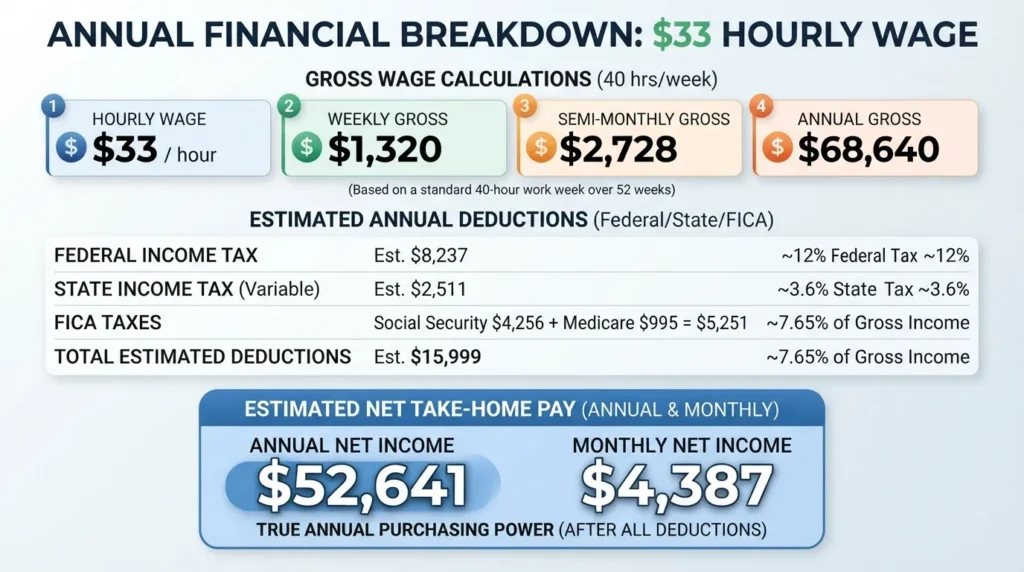
Earning $33 an hour translates to a solid middle-class income, but what lands in your bank account depends heavily on taxes and your filing status. Based on a standard full-time schedule of 40 hours a week for 50 weeks (or 2,080 hours annually), your gross yearly earnings start at $68,640. However, mandatory federal income taxes and Federal Insurance Contributions Act (FICA) deductions trim that number down before you ever see it. This guide breaks down your exact take-home pay for 2026 across different filing statuses, accounting for standard deductions, FICA withholdings, and how state taxes will shift your final net income.
$33 an Hour Salary Calculator
Use the interactive estimator below to calculate your personalized take-home pay based on your exact hours, filing status, and location.
🧮 Interactive Paycheck Calculator Widget
Hourly Wage: $33.00 (Adjustable)
Hours Per Week: 40 (Default for full-time, 2,080 hours/year)
Filing Status: Single | Married Filing Jointly | Head of Household
State: Select State (State taxes vary from 0% in states like Texas and Florida to over 9% in states like California and New York)
Estimated Results Preview:
Gross Annual Salary: $68,640
Federal Income Tax: Approximately $5,360 for Single filers / Approximately $4,350 for Married filers
FICA Tax (Social Security + Medicare): Approximately $5,251 (7.65%)
Estimated Net Take-Home Pay: $57,100 to $59,500 (Before state and local taxes)
Calculate your exact take-home pay using our full Paycheck Calculator & Hourly-to-Salary Tool.
$33 an Hour Is How Much a Year? The Math
Converting an hourly wage to an annual salary is straightforward once you apply the standard financial formulas. While your gross earnings look great on paper, understanding how different schedules and unpaid time off impact your baseline helps you budget accurately.
The Formula — Hourly × Hours/Week × 52 Weeks
To find your baseline annual gross income, you multiply your hourly wage by the number of hours you work each week, and then multiply that total by the 52 weeks in a calendar year.
Step-by-Step Calculation ($33 × 40 × 52 = $68,640)
Here is how the math breaks down for a standard full-time schedule:
Hourly Wage: $33.00
Weekly Hours: 40 hours
Weekly Gross Pay: $33.00 $\times$ 40 = $1,320
Annual Gross Pay: $1,320 $\times$ 52 weeks = $68,640
Based on 2,080 total work hours per year (40 hours $\times$ 52 weeks).
| Weeks Worked Per Year | Calculation Breakdown | Annual Gross Pay |
|---|---|---|
| 52 Weeks (Full Year) | $33 × 40 hrs × 52 weeks | $68,640 |
| 50 Weeks (2 Weeks Unpaid Leave) | $33 × 40 hrs × 50 weeks | $66,000 |
| 48 Weeks (4 Weeks Unpaid Leave) | $33 × 40 hrs × 48 weeks | $63,360 |
$33 an Hour After Taxes — Full Take-Home Breakdown 2026
Earning $33 an hour equals a full-time gross salary of $68,640 per year (based on 40 hours a week for 52 weeks). However, the amount that hits your bank account depends on mandatory federal taxes and your filing status.
| Pay Period | Gross Pay | Net Pay (Single) | Net Pay (Married) |
|---|---|---|---|
| Hourly | $33.00 | ~$27.14 | ~$28.16 |
| Weekly | $1,320 | ~$1,098 | ~$1,144 |
| Biweekly | $2,640 | ~$2,197 | ~$2,289 |
| Monthly | $5,720 | ~$4,760 | ~$4,959 |
| Annual | $68,640 | ~$57,118 | ~$59,512 |
How State Taxes Change Your $33/hr Take-Home Pay
While federal and FICA taxes apply universally across the United States, your geographic location plays a major role in determining your final net income. Depending on where you live, state income taxes can either leave your paycheck untouched or slice off a notable percentage.
| State Category | Example States | Estimated State Tax Rate | Estimated Annual Net Take-Home (Single) |
|---|---|---|---|
| No-Income-Tax States | Texas, Florida, Nevada, Washington | 0% | ~$57,110 |
| Moderate Tax States | Pennsylvania, Illinois, Ohio | ~3.0% to 5.0% | ~$54,500 – $55,800 |
| High Tax States | California, New York, Oregon | ~6.0% to 9.0%+ | ~$51,200 – $53,500 |
$33 an Hour With Overtime — Yearly Pay Table
If your job regularly requires working beyond a standard 40-hour workweek, your earnings can increase substantially due to overtime pay rules. Under federal law (FLSA), non-exempt employees who work more than 40 hours in a single workweek are entitled to time-and-a-half for every extra hour worked.
Standard Hourly Rate: $33.00/hr
Overtime Rate (1.5$\times$): $49.50/hr
| Hours Worked | Standard vs. Overtime Breakdown | Annual Gross Pay | Estimated Annual Net Pay |
|---|---|---|---|
| 40 Hours | 40 + 0 | $68,640 | ~$57,118 |
| 45 Hours | 40 + 5 | $81,510 | ~$66,400 |
| 50 Hours | 40 + 10 | $94,380 | ~$75,100 |
| 55 Hours | 40 + 15 | $107,250 | ~$83,500 |
| 60 Hours | 40 + 20 | $120,120 | ~$91,800 |
$33 an Hour as a 1099 Contractor — After-Tax Difference
Transitioning from a traditional W-2 employee to a 1099 independent contractor changes how your earnings are taxed. While contractors often enjoy greater schedule flexibility and higher headline hourly rates, they carry a heavier tax burden because employers no longer split payroll taxes with them.
Self-Employment Tax (15.3%) vs W-2 FICA (7.65%)
The biggest financial shift for a 1099 contractor involves the Self-Employment Tax, which covers both Social Security and Medicare:
W-2 Employees: Pay half of FICA taxes (7.65%), while the employer pays the matching 7.65% behind the scenes.
1099 Contractors: Act as both the employer and the employee, meaning they must pay the entire 15.3% self-employment tax rate on their net earnings (up to the annual Social Security wage base limit).
In addition to double the tax rate on earnings, 1099 contractors must budget for their own federal, state, and local income taxes, quarterly estimated tax payments, and the lack of traditional employee benefits like paid time off, health insurance, and employer 401(k) matches.
What Contractor Rate You’d Need to Match $33/hr W-2 Take-Home
Because of the extra 7.65% self-employment tax, the cost of self-employment tax deductions, and out-of-pocket expenses (like purchasing your own health insurance and paying for unpaid sick days), making $33 an hour as a contractor leaves you with significantly less take-home pay than making $33 an hour as a W-2 employee.
To match the exact net take-home pay of a $33/hr W-2 position (~$57,118 net for a single filer), a 1099 contractor generally needs to charge between $41.00 and $45.00 per hour just to break even after factoring in self-employment taxes, business expenses, and lost benefits.
Is $33 an Hour a Good Salary in 2026?
Earning $33 an hour—which totals roughly $68,640 a year for a standard full-time schedule—is a competitive and respectable wage in the United States, hovering very close to national benchmarks.
How It Compares to National Benchmarks
Compared to US Median Income: According to U.S. Bureau of Labor Statistics (BLS) and U.S. Census Bureau data, the median full-time individual wage sits around $64,220 annually ($1,235 per week). A $33/hr wage places you slightly above the typical middle-income earner nationwide.
Compared to Average US Hourly Earnings: BLS data tracks overall average private nonfarm payroll earnings at approximately $37.64 per hour. While $33/hr falls slightly below this broad national private-sector average (which is heavily skewed by high-comp sectors like tech, finance, and utilities), it remains a solid, stable baseline for skilled trades, healthcare support, and administrative professions.
Cost-of-Living Reality: Location Matters
How far your $33 an hour stretches depends entirely on your local economy:
Comfortable in Lower-Cost Areas: In smaller metros, the Midwest, the South, and rural regions, $68,640 a year provides a comfortable middle-class lifestyle, easily covering median rent or mortgage payments, groceries, and savings.
Tight in High-Cost Metros: In high-cost-of-living cities like San Francisco, New York City, Boston, or Seattle, a $33 hourly wage can feel restrictive. Skyrocketing housing, transportation, and utility costs mean your net take-home pay will be heavily squeezed, often requiring budgeting or shared housing.
Frequently Asked Questions
How much is $33 per hour in salary?
Earning $33 per hour translates to an annual gross salary of $68,640, assuming a standard full-time schedule of 40 hours a week for 52 weeks (2,080 total hours).
How much is $33 an hour for 40 hours a week annually?
At 40 hours a week for 52 weeks, your gross yearly earnings equal $68,640 before taxes and deductions are applied.
How much is $33 an hour after taxes?
After federal income tax and FICA withholdings, your net take-home pay is approximately $57,118 for a single filer and $59,512 for a married filer filing jointly (before state and local taxes).
How much is $70,000 a year hourly?
A $70,000 annual salary breaks down to approximately $33.65 per hour based on a standard 40-hour workweek over 50 weeks. Read our detailed breakdown in our Annual-to-Hourly Salary Calculator and Guide.
Is $33 an hour good pay in 2026?
Yes, $33 an hour ($68,640/year) sits slightly above the U.S. median individual income. It provides a comfortable middle-class lifestyle in lower-cost and mid-sized metros, though it can feel tight in high-cost-of-living cities like New York or San Francisco.
How does filing status (single vs married) change my $33/hr take-home?
Filing status alters your standard deduction and federal income tax brackets; single filers receive a lower standard deduction and face higher taxable income, resulting in an effective federal tax rate of ~16.8%, compared to ~13.3% for married filing jointly.
Is overtime taxed at a higher rate on $33/hr?
No, overtime hours are not taxed at a special higher tax rate by the IRS; they are simply taxed at your normal marginal income tax bracket based on your total annual earnings.
📌 Related Articles You Might Like
Working In New York Living In New Jersey Tax Calculator
https://payscheckcalculator.com/blog/working-in-new-york-living-in-new-jersey-tax-calculator/
Visit This Blog →Commission Paycheck Calculator
https://payscheckcalculator.com/blog/commission-paycheck-calculator/
Visit This Blog →$12 An Hour Is How Much A Year After Taxes
https://payscheckcalculator.com/blog/12-an-hour-is-how-much-a-year-after-taxes/
Visit This Blog →How To Fill Out A W4 If Married Filing Jointly
https://payscheckcalculator.com/blog/how-to-fill-out-a-w4-if-married-filing-jointly/
Visit This Blog →$13 An Hour Is How Much A Year After Taxes
https://payscheckcalculator.com/blog/13-an-hour-is-how-much-a-year-after-taxes/
Visit This Blog →
Written & verified by Daniel R. Whitmore
Founder & Developer, PayCheckCalculator.com
Last updated: July 2026
0 Comments